
Lessons and activities
The big picture
To support your teaching practice, the Holocaust Centre of New Zealand provides a comprehensive suite of high-quality, research-based unit plans, lessons and activities. These resources are designed to be flexible-suitable for a single lesson or as part of a larger unit of work-and are fully aligned with the New Zealand Curriculum.
FEATURED
We Were Just Children - Film series & activities
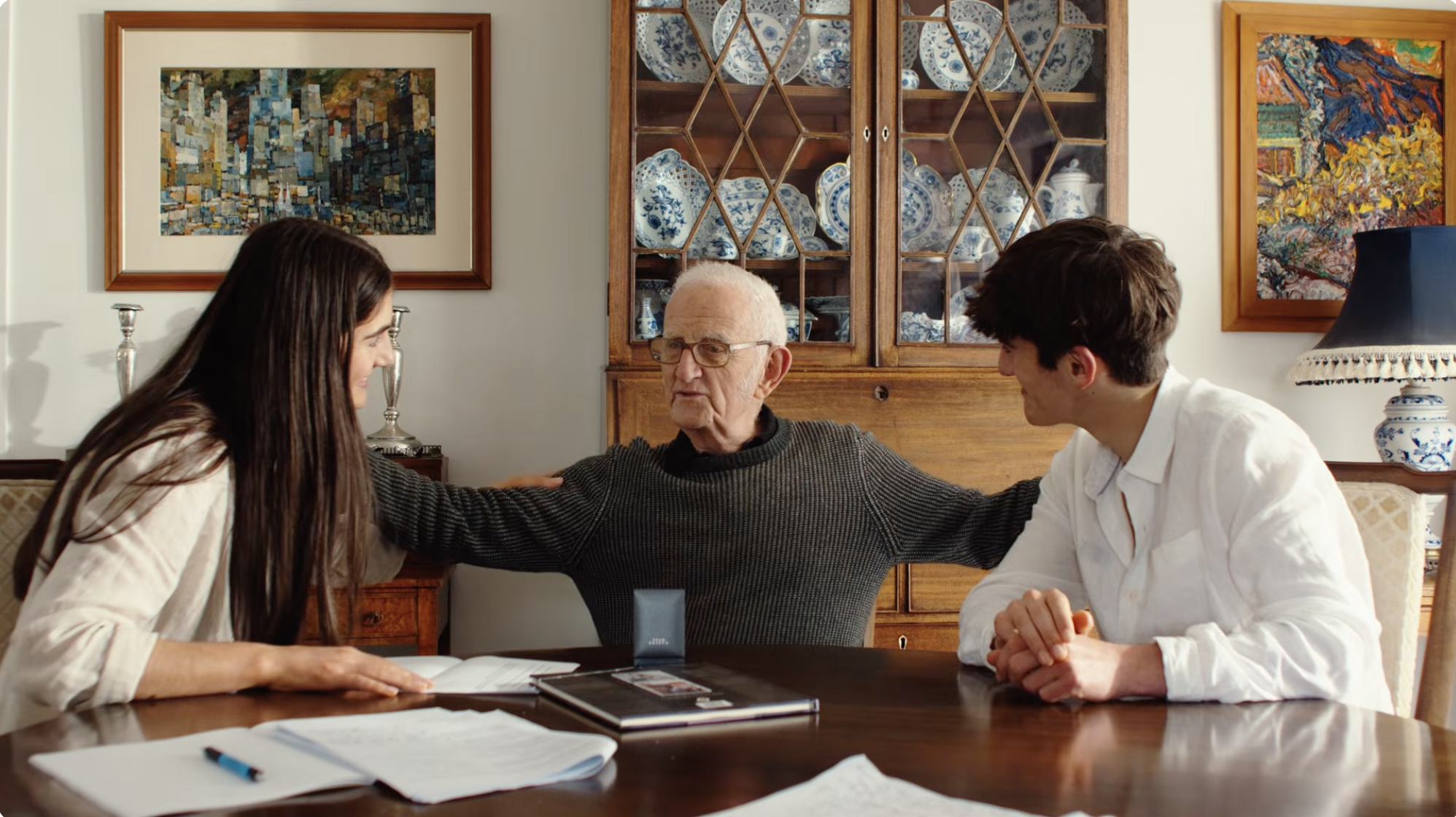
This powerful educational resource is specifically created for Years 7–10, connecting the lived experiences of New Zealand Holocaust survivors directly to our world today. Comprising one film broken into four sections for ease of use in the classroom, the series utilises deeply moving survivor testimonies, newly filmed interviews, and carefully crafted visual storytelling. Rather than just teaching history, these lessons explore how easily prejudice can become policy, how societies slide into violence, and why standing up against antisemitism is a shared responsibility. Each section is paired with structured classroom activities designed to foster empathy, critical thinking, and civic courage in the next generation. Film is rated PG.
Cost: Free
Endorsed by the NZ History Teachers Association (NZHTA).
Register for free access below
Already have an account?
Learning outcomes
Identify how historical events connect to the present day and understand the mechanisms through which prejudice can normalise within a society.
Analyse the role of individual choice and collective responsibility in preventing discrimination and standing up against hatred.
Reflect on the concepts of resilience, courage, and identity by exploring how child survivors rebuilt their lives in New Zealand.
Curriculum links
Social Sciences (Levels 4–5): Understand how places influence people and people influence places; Understand how the past shapes the present and future; Explore how people participate individually and collectively in response to community challenges.
English (Levels 4–5): Show a developing understanding of ideas within, across, and beyond texts; Think critically about how language features and visual elements are used to communicate human experiences and perspectives.
Trailer for We Were Just Children (2026)
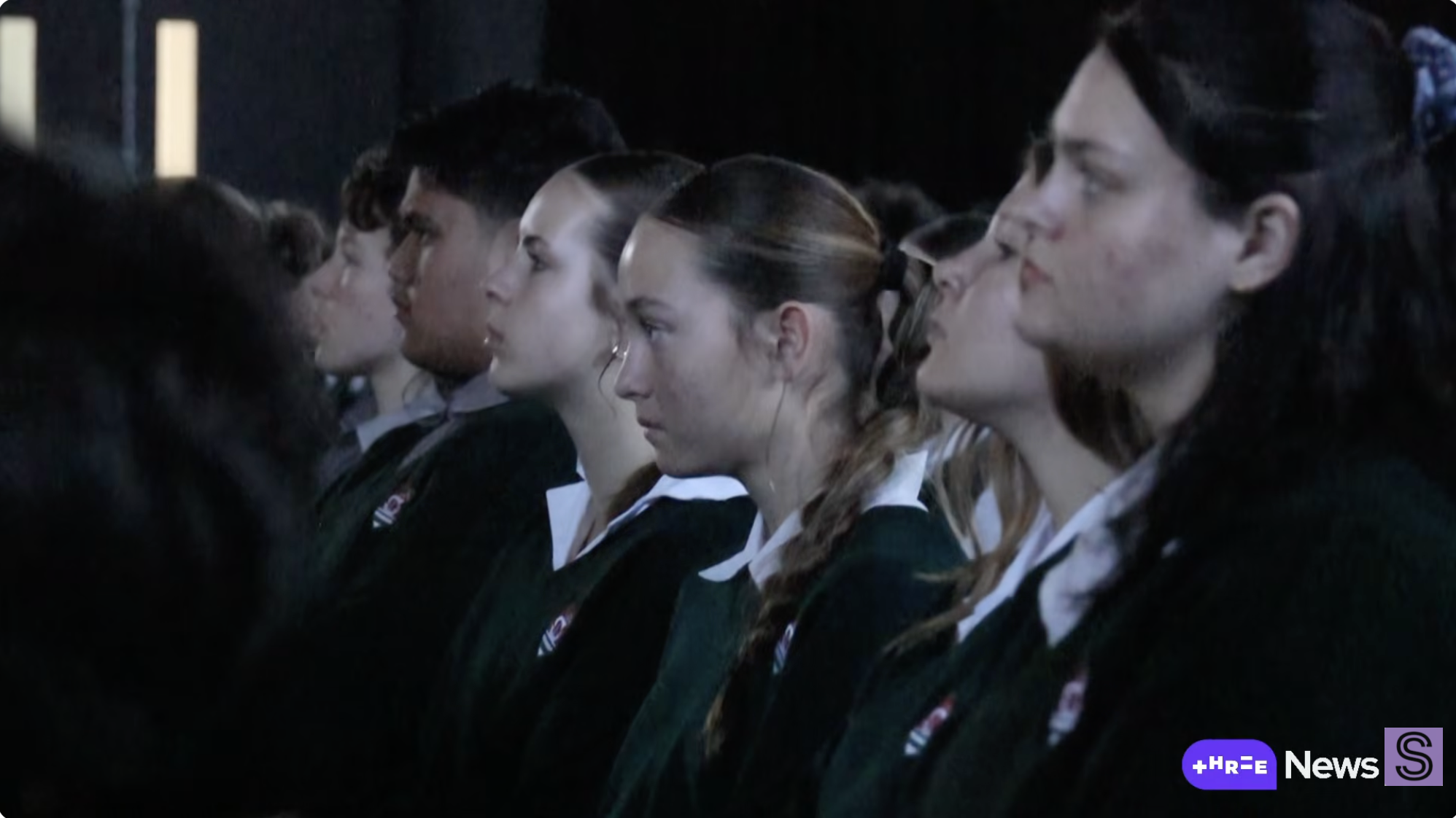
See how the We Were Just Children film series resonated with children on Three News
-
About this resource: This comprehensive unit plan provides educators with a structured approach to defining and discussing antisemitism. It traces the history of "the oldest hatred”, from its religious roots to its modern-day manifestations. The lesson is designed to help students identify antisemitic tropes and understand how prejudice is normalised within a society. It includes primary source analysis and discussion prompts that connect historical antisemitism to current issues in New Zealand.
Learning outcomes
Define antisemitism and identify its historical and contemporary forms.
Analyse how hate speech and stereotypes contribute to the dehumanization of a group.
Reflect on personal and societal responsibilities in challenging prejudice in New Zealand today.
Curriculum links
Social Sciences (Level 6-8): Understand how people’s perspectives on past events that are of significance to New Zealanders differ; Understand how the causes and effects of events have a range of outcomes.
Health & PE: Relationships and Sexuality Education (Identity, discrimination, and the impact of prejudice on wellbeing).
-
About this resource: Based on the story of Sir Nicholas Winton and the Kindertransport, this activity guide is designed for use after students have viewed the film One Life or studied the rescue of Jewish children. It focuses on the ethics of rescue, the logistical challenges of the Kindertransport, and the lasting impact of "the power of one." It includes guided discussion questions that challenge students to reflect on what they would do if they were in a position of agency during a crisis.
Cost: Free
Learning outcomes
Critically evaluate the moral and ethical dilemmas faced by rescuers during the Holocaust.
Analyse the historical significance of the Kindertransport within the wider context of refugee history.
Curriculum links
English (Level 7-8): Respond critically to significant connections across texts, supported by evidence (Film study alignment).
History: AS91229 (Interpret different perspectives of a significant historical event).
-
About this resource: Zikaron BaSalon is a unique, communal way of commemorating the Holocaust through storytelling and dialogue. Traditionally held in homes, this kit adapts the experience for the classroom. It provides a structured framework for students to engage with survivor testimony in a more intimate, reflective setting.
SOPHIA GALLER
Zofia "Sophia" Galler was born in Katowice, Poland, in 1929 to her father, Hilary Minc, and her mother, Cecilia Kronenblum.
When the war began in 1939, Sophia was only ten years old, and the Minc family was forced out of Katowice as it was being declared "Judenfrei", "Free of Jews."
In 1941, Sophia and her parents were interred in the Sosnowiec ghetto. In 1942, Sophia and her mother were forced to watch the execution of her father, who had been caught trying to arrange an escape for his wife and daughter. By the end of 1942, Sophia and her mother had been deported to the Auschwitz-Birkenau death camp, where they met Dr Josef Mengele himself. When Mengele chose them to work, Cecilia told Sophia, "remember, you have to be strong because I will never come out of here." It was a prophetic statement, as her mother did not survive Auschwitz.
While on a death march from Auschwitz, Sophia and another prisoner managed to escape, hiding from the Nazis and their collaborators until a black American soldier found them. After liberation and being taken care of by the Americans, she returned to Katowice to find that her family home had been taken by a Polish family who slammed the door in her face. She moved to New Zealand in 1952 with her new husband, Anton Galler, whom she met in Israel. She had two sons, both of whom live in New Zealand.
The Sophia Galler kit is recommended for Senior students only.Please watch the testimony before showing to your students.
HAN KLISSER
Johan "Han" Klisser was born in Amsterdam, Netherlands, in 1927 to parents Leentje Kok and Elkan Klisser. His mother was a homemaker while his father was a travelling salesman, and he had a younger brother Leo Klisser born in 1936.
World War II began when Han was 12 years old, with restrictions on Jews coming into place immediately after the Nazis took over The Netherlands: curfews, expulsions from public schools, compulsory wearing of the yellow star, and more. Soon after his bar mitzvah in 1940, Johan and his family were arrested by the Sicherheitsdienst (SD), the Security Service of the Nazis. Hans' father was able to get the family released before deportation by paying someone to release them and change their papers. The family would be split for the next few years and sent to different hiding places. The last tie that Hans saw his parents was on his 16th birthday, but after the end of the war, he learned that the Nazis had murdered his parents, brother, and most of his extended family.
In 1951, Hans moved to New Zealand with only $20 in his pocket, where he met his future wife, Janna Dettingmeijer. They married in 1956 and had four children, three girls and a boy.
Han is known throughout New Zealand as the founder of Vogel's Bread, having started the brand alongside fellow refugee Dr Max Reizenstein, delivering the bread to purchasers on a bicycle. After buying out Dr Reizenstein, Han and Janna established Klisser's Farmhouse Bakery and the line of the now-famous bread in New Zealand.
HANKA PRESSBURG
Hanka Pressburg was born in Rakovnik, Czechoslovakia in 1920 to Josef and Ruzena Švarc. She lived with her parents and brother above her father's shop until she went to Prague for school, where she learned German and French. While not a religious family, the Švarc's kept major Jewish holidays and had excellent relations with their Christian neighbours.
When the Nazis invaded Czechoslovakia, Hanka and her family were subjected to increasingly harsh restrictions against Jews. She married her first husband, Fricek Weil, in 1941 and soon after, in 1942, Hanka, her husband, and her family were deported to the ghetto-transit camp Terezin (Theresienstadt).
She lived there until Dec 1943, when Hanka and Fricek were deported to Auschwitz. Hanka would survive Auschwitz, but unfortunately, Fricek would be murdered there. When she was liberated by the British in 1945 from Bergen-Belsen, Hanka survived six camps and multiple death marches.
She married her second husband, George (Jiří) Pressburg in 1947 and moved to New Zealand in 1950, where she had two daughters, Carol and Susie.
Hanka and George are considered the founders of Holocaust education in New Zealand and were instrumental in setting up the Holocaust Centre of New Zealand.FRED SILBERSTEIN
Alfred "Fred" Silberstein was born in Berlin in 1927. His father owned a haberdashery business that the Nazis eventually destroyed during the Kristallnacht pogrom on 9 - 10 Nov 1938. During that pogrom, Fred's father was deported to Sachsenhausen, and when he was eventually released back to the family, he was a "broken man."
Fred was forced to work at the infamous Wannsee Conference when the SS picked him up to be a servant. Because he was blonde-haired and blue-eyed, he was often mistaken for being an Aryan. When he was found out to be a Jew at Wannsee, he was given the chance to renounce his Judaism but Fred refused. In February 1943, at almost 16 years old, Fred was deported to the Auschwitz-Birkenau death camp. His survival at selection was down to his lying about his age and being chosen as a candidate for hard labour. During his time in Auschwitz, Fred met the notorious Dr Josef Mengele, who selected him in 1944, for experimentation and torture. He was operated on without anaesthetics, injected with chemicals, and sewn back up, all for the Nazis to learn how to improve healing for Nazis soldiers injured on the battlefield. When the Nazis emptied Auschwitz, Fred was taken on an infamous death march to Nordhausen, where the Americans liberated him in 1945 at 19 years old.
Due to his experiences in the concentration camps and what he witnessed at Wannsee, Fred was a witness for the American prosecutors at the Nuremberg Trials from November 1945 to October 1946.
Before moving to New Zealand in the late 1940s, Fred discovered that his sister, Hansi Keating, had survived and was living in Frankfurt. They moved to Auckland, where Fred had his own restaurant and would speak to school and adult groups about his Holocaust experiences.
The Fred Silberstein kit is recommended for Senior students only.Please watch the testimony before showing to your students.
CLARE GALAMBOS-WINTERKlara "Clare" Galambos-Winter was born in Szombathely, Hungary, into a family of musicians. Clare was an incredibly talented player, moving to Budapest at 16 to attend a music conservatory.
During World War II, her family was forced from their home and into a ghetto, then deported to the Auschwitz-Birkenau death camp. Clare's mother, brother, and father were murdered there, but Clare and her aunt Rosie, were sent on to Kassell to work as slave labour in a munitions factory until the war ended.
The sold survivors of their family, except for one other cousin, Clare and Rosie were liberated by the Americans in Buchenwald after surviving a death march to the camp.
They came to New Zealand as refugees in 1949, joining relatives who had settled here 40 years earlier. Clare played in the 2YA radio orchestra until being appointed to the National Orchestra in 1951, retiring in 1983 after 33 years in the first violin section.
She maintained an active musical life after retirement, playing in chamber music ensembles and teaching music appreciation classes.Cost: Free
Learning outcomes
Develop empathy and active listening skills through engagement with personal testimony.
Understand the importance of oral history in preserving collective memory.
Curriculum links
Social Sciences (Level 4-8): Understand how the past is represented and interpreted in different ways.
Drama/Oral History: Exploring the power of testimony and narrative performance.
-
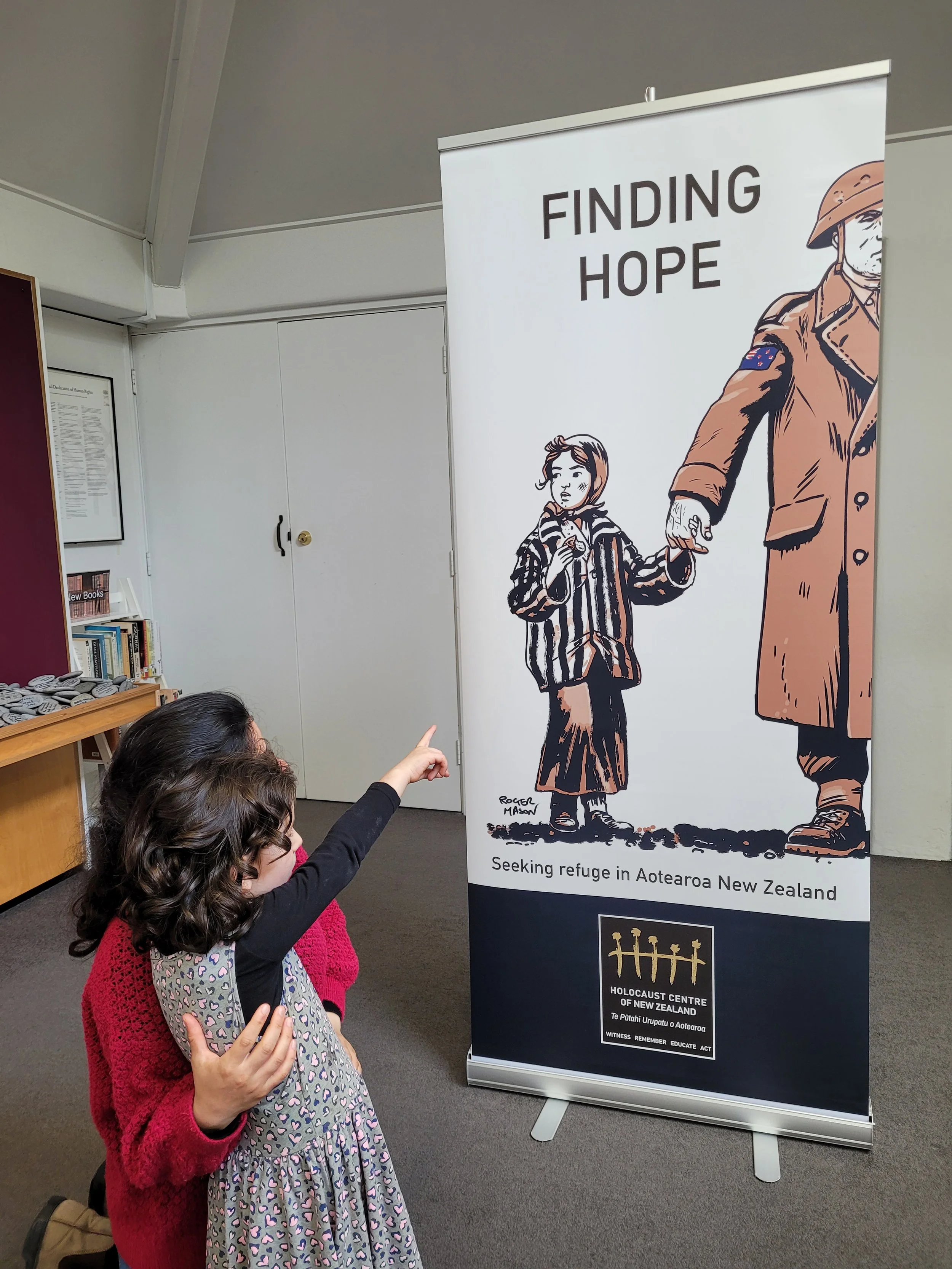
This is a powerful narrative experience that focuses on the resilience and courage of Holocaust survivors who eventually settled in New Zealand. This resource, produced in a graphic novel style, provides a local lens on global tragedy, helping students understand that these stories are part of our own national history.
The narrative: The exhibition tracks the journey from life before the Holocaust, through the darkness of the camps and hiding, to the challenges and triumphs of starting a new life in New Zealand.
Key themes: Resilience, the meaning of "home," and the enduring power of hope in the face of absolute adversity.
Educational use: The exhibition materials include guided discussion points and reflective activities to help students process these deep personal testimonies safely. The exhibition comprises eight pull-up banners, a teaching resource booklet, activities and further programme support.
Availability: Exhibition is available for loan to schools across the country. It is a perfect accompaniment to our virtual sessions or as a standalone classroom resource.
Cost: Free to loan, however a refundable* $350 deposit is required to cover any mishaps. (refundable on return in the condition sent)
Shipping costs additional. We would appreciate a koha to cover shipping.
Duration: Years 9-10 can hire for four weeks, Years 11-13 can hire for a term.
The Finding Hope: Seeking Refuge in Aotearoa New Zealand exhibition was illustrated by Roger Mason..
To make a booking request please fill in the following form.
https://hcnz.outreach.co.nz/forms/findinghope
You can also obtain the following accompanying PDF
-
About this resource: Specifically curated to accompany our digital sessions, these activities ensure that students remain engaged and proactive during online learning. This pack includes pre-session briefing notes to prepare students for the sensitive nature of the topic, interactive digital worksheets to be used during the live session, and reflection prompts for post-session follow-up. These tools ensure that the "Safely In, Safely Out" methodology is maintained even in a remote learning environment.
Cost: Free
Download 'Understanding the Holocaust' lesson and activities
Download 'Liberation and migration to Aotearoa' lesson and activities
Learning outcomes
Synthesise information delivered via digital platforms into coherent historical arguments.
Engage safely and ethically with digital archives and recorded testimonies.
Curriculum links
Digital Technologies: Using digital tools to explore and communicate complex historical narratives.
Social Studies (Level 5-7): Continuity and Change; Identity, Culture, and Organisation.
-
Just One Week is a concentrated, high-impact teaching resource designed to be delivered over five consecutive days. It provides a structured framework for teachers to introduce the complex history of the Holocaust in a way that is manageable, safe, and academically rigorous. Just One Week tells the story of the Holocaust through the lives of three survivors who eventually made their way to New Zealand after the end of World War II.
Endorsed by the New Zealand History Teachers' Association.
The structure: Each day focuses on a specific theme, from the humanisation of the victims to the legacy of remembrance. For each session we ensure a ‘Safely In, Safely Out’ experience for the class.
Ready-to-use: The resource includes ready-made lesson plans, PowerPoint presentations, and student worksheets, reducing preparation time for busy educators.
Why it works: It offers a clear, guided pathway through a difficult subject, ensuring that the essential historical facts are covered while leaving space for meaningful reflection.
Availability: Available any time. Downloadable files and video testimony.
Cost: Free.
Before, during and after the Holocaust with reference to Holocaust survivor Bob Narev’s story.
-
LEVEL 1 NCEA ASSESSMENT - STANDARD 92024
Engage with a variety of primary sources in a historical context.
Our NCEA Level 1 History (Standard 92024) assessment supports student learning about the causes and consequences of Kristallnacht. Allowing student choice of focus question, this task enables students to select a variety of primary sources from a Resource Pack, identify the main ideas in the evidence, and reflect on the strengths and limitations within and across the collection of sources.
History 1.1 causes or consequences of Kristallnacht: Resource Pack
History 1.1 Student Instructions
LEVEL 2 NCEA ASSESSMENT - STANDARD 91229
Carry out an inquiry of an historical event or place that is of significance to New Zealanders
Our assessment for NCEA Level 2 History (Standard 91229) supports student learning on an aspect of their choice within the historical context of Nazi Germany and/or the Holocaust. Ideally, this task would follow an in-class programme of learning on the Holocaust. Students identify a topic of interest, develop a focussing question(s) using the examples provided, gather and organise sources, make perceptive annotations on the evidence, and evaluate their inquiry process.
This assessment can be used on its own or combined with the History 2.2 standard.
History 2.1 Student Instructions (with 2025 RAMP changes)
History 2.1 Assessment Schedule (combined with 2.2)LEVEL 2 NCEA ASSESSMENT - STANDARD 91230
Examine a historical event or place that is of significance to New Zealanders
Our assessment for NCEA Level 2 History (Standard 91230) supports student learning on an aspect of their choice within the historical context of Nazi Germany and/or the Holocaust. Ideally, this task would follow an in-class programme of learning on the Holocaust. This task is specifically designed to use along with the 2.1 Inquiry. Students communicate key historical ideas through a convincing explanation of their chosen aspect, use supporting evidence and explain the significance of the Holocaust to New Zealanders.
History 2.2 Student Instructions
History 2.2 Assessment Schedule (combined with 2.1)
-
The Teaching Trunks are a unique, tactile resource designed to bring the history of the Holocaust directly to your students. Each trunk is a "mobile museum" filled with primary source replicas, literature, and hands-on materials that allow students to engage with history in a physical, tangible way. A teaching guide and activities are included.
What’s inside: A curated selection of books, maps, links to videos and activities, and authentic replicas of artefacts that tell the personal stories of survivors and victims.
Curriculum focus: These resources are designed to support social studies, history, and english, encouraging critical thinking and empathy.
Availability: Trunks are available for loan to schools across the country. They are a perfect accompaniment to our virtual sessions or as a standalone classroom resource.
Cost: Free to loan, however a refundable $350 deposit is required to cover any mishaps. Shipping costs additional. We would appreciate a koha to cover shipping.
Duration: Minimum four week hire, one term maximum.
If you would like to book a trunk
Go to
https://hcnz.outreach.co.nz/forms/teachingtrunk
Or for more information please contact Education Director Kris Clancy at educdirector@holocaustcentre.org.nz
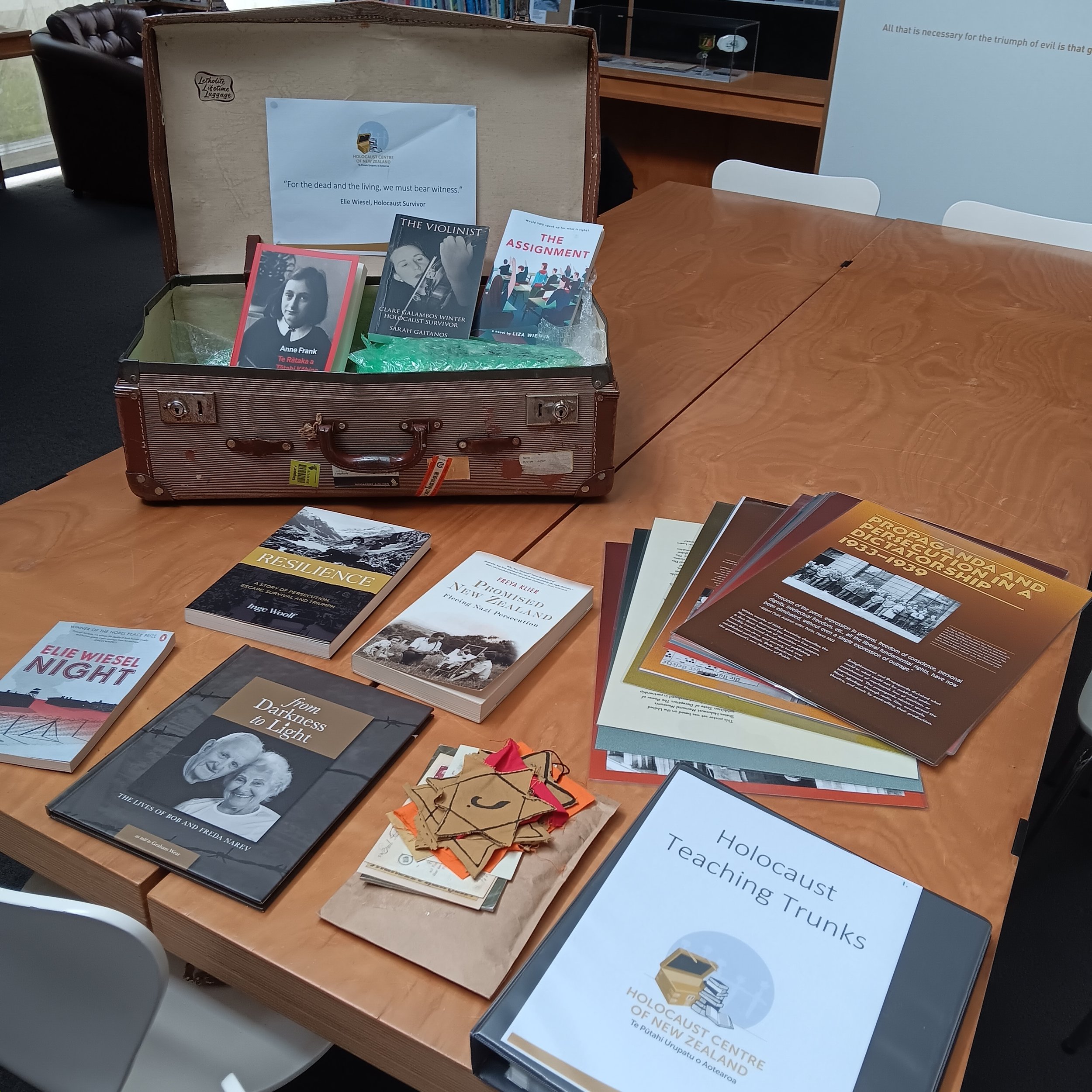
Contents of a Teaching Trunk
The Finding Hope: Seeking Refuge in Aotearoa New Zealand exhibition
Just One Week, a secondary school teaching resource