
New Zealand and the Holocaust
A Parallel Timeline of Global History and Local Response (1931–1949)
While the “Final Solution” was being implemented in Europe, what was happening here in New Zealand?
This timeline tracks the local response – from the restrictive immigration policies of the 1930s and the classification of Jewish refugees as “enemy aliens”, to the Kiwi soldiers who witnessed the liberation of the camps. It provides a vital context for understanding how our government and society navigated one of the greatest moral crises of the 20th century.
This resource provides a chronological overview of the Holocaust's major global events, contrasting international history with New Zealand's political, legislative, and humanitarian responses.
In Europe
1931 – 1938: The Rise of Persecution and Early Restrictions
1933
30 January 1933: Hitler appointed Chancellor.
27 February 1933: Burning of the Reichstag.
22 March 1933: The first concentration camp opened at Dachau (the longest-operating camp).
1 April 1933: Nationwide boycott of Jewish businesses.
7 April 1933: The "Law for the Restoration of the Professional Civil Service" excludes Jews and other political opponents from civil service positions.
1934
President Hindenburg dies in office; Hitler combines the roles of Chancellor and President, becoming Commander-in-Chief of Germany
1935
15 September 1935: The antisemitic, racist Nuremberg laws were enacted, defining Jews and sanctioning the final social and legal separation of Jews from non-Jews.
President Hindenburg dies in office; Hitler combines the roles of Chancellor and President, becoming Commander-in-Chief of Germany
1937
15 July 1937: Concentration camp at Buchenwald opens.
8 November 1937: "Der Ewige Jude" (The Eternal Jew), a major antisemitic exhibition, opens in Munich, Germany and travels the country, exhibiting in Berlin from November 1938 to January 1939.
1938
12 March 1938: Anschluss: Germany annexes Austria.
Italy joins Germany in passing anti-Jewish "Racial Laws."
September 1938: Munich agreement (England and France accept Germany’s annexation of parts of Czechoslovakia, and British PM Neville Chamberlain famously declares “peace in our time”.
5 October 1938: German Jews’ passports declared invalid - until stamped with a red letter “J”.
9-10 November 1938: Kristallnacht (‘Night of broken glass’ - named after the shattered windows of Jewish shops). In this nationwide pogrom, 1,400 synagogues are attacked, Jewish shops are looted, at least 91 Jews are killed, and 30,000 Jewish men are arrested and sent to concentration camps.
December 1938: The first Kindertransport (Children's Transport) rescues Jewish children; between 9,000 and 10,000 Jewish children would eventually be saved.
1939
October 1939: Hitler declares that the war will mean the end of Europe’s Jews.
October 1939: Hitler declares that the war will mean the end of Europe’s Jews.
1940
January 1940: Jewish property in Poland registered
April-May 1940: Germany invades and quickly defeats Denmark, Norway, the Netherlands, Belgium and France.
10 May 1940: Winston Churchill becomes British PM.
26 May 1940: The British Navy rescues over 300,000 Allied troops (British, French and Belgian) at Dunkirk
October 1940: Vichy France enacts the “Jewish Statute”, adopting the Nuremberg Laws’ biological definition of Jews.
Late 1940-Mid 1941: Ghettos at Warsaw, Krakow and Lodz are sealed.
1941
March 1941: Construction of Auschwitz death camp begins.
June 1941: Nazi Germany invades the Soviet Union. Einsatzgruppen (SS death squads) begin the mass murder of Jews and communists, killing 1.25 million Jews and hundreds of thousands of Soviet nationals by 1943.
June-July 1941: Occupying Vilna, Nazis and Lithuanian collaborators deport local Jews to the Ponary forest for execution and mass burial.
July 1941: Goering orders Heydrich to prepare a plan for the “Final Solution of the Jewish Problem"
September 1941: First experimental gassings at Auschwitz.
November 1941: A "Model Camp" is established at Theresienstadt. Between 1941 and 1945, of the 140,000 Jews sent here, over 32,000 die due to intolerable conditions, and nearly 87,000 are deported to Auschwitz.
December 1941: Chelmno camp becomes operational using static gas vans for the extermination of some 320,000 people from nearby areas, Lodz ghetto, Germany, Austria, Czech lands and Luxembourg.
October 1941: Mass deportations of German, Czech and Austrian Jews to the Lodz ghetto, en route to Chelmno extermination camp.
1942
20 January 1942: Wannsee Conference in Berlin, involving senior Nazi Government and SS officials meeting to coordinate the implementation of the ‘Final Solution’ – the murder of 11 million Jews - the total Jewish population across Europe, North Africa, and the Middle East.
March 1942: Auschwitz-Birkenau was established. Birkenau was the largest of the more than 40 camps and sub-camps that made up the Auschwitz complex. It was the main extermination centre; Most of the over 1.1 million people killed at Auschwitz were murdered here, 90% of them were Jews.
17 March 1942: Belzec extermination camp opens. The first of the Reinhard concentration camps opens on the Belzec railway line. Historians estimate that between 434,500 and 600,000 Jews were murdered at the Belzec extermination camp by December 1942.
May 1942: Mass killings begin at Sobibor extermination camp. An estimated 250,000 Jews would be murdered at Sobibor - nearly 100,000 in the first two months alone.
July 1942: Killing by gas begins at Treblinka extermination camp - one of three such camps along with Sobibor & Belzec – established under “Operation Reinhard”.
July-December 1942: Mass deportations from the Warsaw Ghetto to Treblinka.
1943
February 1943: German defeat at Stalingrad
19 April 1943 - 16 May 1943: Warsaw Ghetto Uprising
2 August 1943: Treblinka Uprising
1944
15 May- 9 July 1944: 437,000 Hungarian Jews are deported, mostly to Auschwitz.
25 November 1944: Himmler orders the destruction of Auschwitz gas chambers and crematoria
December 1944: The last gassing of inmates at the Hartheim killing centre in Austria. Hartheim was one of six killing facilities established by the Nazis as part of the mass murder of people with disabilities, the "Aktion T4” program. Between 1940 and 1944, an estimated 30,000 people were killed here.
1945
January 1945: Death March of 60,000 Auschwitz prisoners begins – 15,000 perish along the 60 km trek.
27 January 1945: Soviet forces liberate Auschwitz
April 1945: Allies liberate Buchenwald and Bergen-Belsen
30 April 1945: Hitler commits suicide.
Key New Zealand Events
1931
Immigration Restriction Amendment Act passes: The Act allows free entry to British immigrants (either by birth or descent); others must obtain entry permits. The Act aims to restrict "race aliens" (particularly Jews and Chinese). This superseded the 1920 version.
Permits were only granted if the immigrant had:
Guaranteed employment
A significant amount of capital (money)
Special skills or knowledge that wouldn’t take jobs away from local New Zealanders
1935 Wealthy Jewish philanthropists Annie and Max Deckston bring eight Polish-Jewish orphans from Bialystok to Wellington.
1935
1937
1937 A second group of 12 Jewish children are brought to New Zealand by the Deckstons.
1936-1938
New Zealand rejects an estimated 1,731 applications from Jewish refugees (while granting 727). Thousands more are actively discouraged from applying.
1933-1939
Between 1933 and 1939, New Zealand accepted fewer than 1,500 Jewish refugees.
1939 – 1941: Outbreak of War, Ghettos, and Entry Freeze
1940
24 October 1940: Aliens Emergency Regulations
Under New Zealand Aliens Emergency Regulations, the police and dedicated ”alien” authorities can deport, intern and investigate “aliens” (including Jewish refugees) to assess their loyalty.
June 1940: “Alien” immigration to New Zealand stops.
With the outbreak of war, New Zealand's entry for Jewish refugees is stopped, and the naturalisation of foreign nationals residing in New Zealand is also halted for the war’s duration.
1942– 1945: The “Final Solution”, News Reports, and Liberation
1942
1942 Property Purchases Restricted: New Zealand introduces regulations controlling and restricting land and property purchases by "aliens," including Jewish refugees.
7-8 August 1942: News of Nazi atrocities reach New Zealand.
New Zealand newspapers—including the Evening Post (7 Aug) and Wanganui Chronicle (8 Aug)—publish reports headlined ‘Mass persecution – Jews in occupied countries’, stating that "1,000,000 out of 7,000,000 Jews in the occupied territories have been murdered." This was one of the first reports of this kind published in New Zealand. From 1942 onwards, NZ newspapers published photographs and eyewitness accounts of concentration camps and other atrocities.
14 October 1943: Sobibor Uprising. Prisoners kill 11 SS men and several Ukrainians; some 300 Jews escape. After the uprising, the Germans abandoned Sobibor
1944
16 August 1944: News of the gas chambers reaches New Zealand.
In an article entitled ‘Camp of Annihilation’ (referring to Maidanek, near Lublin), The Press states that ‘...prisoners from all over the world were gassed and thrown into furnaces which could incinerate 1400 bodies daily’
1945
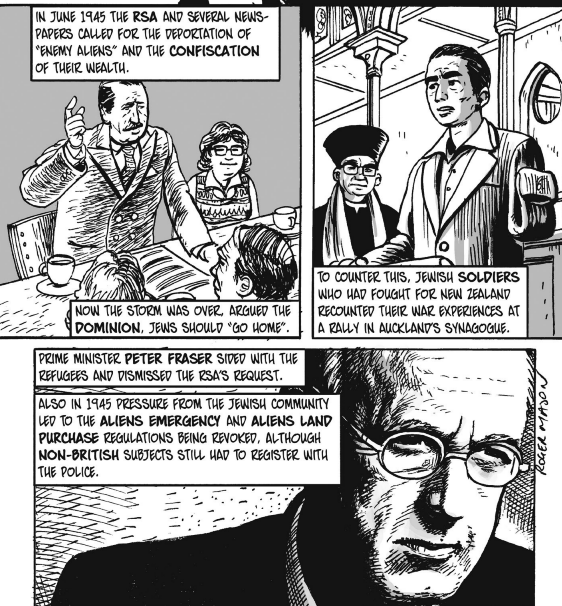
1945 Community Appeals: New Zealand Jewish community requests the government lift wartime restrictions on immigration, naturalisation, and property purchases by refugees. Regulations are revoked, but non-British subjects must still register with the police.
1945 Official Info: Government receives reliable official confirmation of gas chambers.
1945 Immigration Barriers Remain: Naturalisation resumes, but pre-war limits on Jewish immigration continue despite pressure from academics and organisations including the Quakers and the League of Nations Union.
1945 Population Drive: A Select Committee is set up to consider increasing the population—mainly through targeting British settlers.
April - May 1945: The New Zealand merchant ship TSS Monowai aided in crucial 1945 post-WWII missions. The ship sails from England for Odessa on the Black Sea, carrying 1,600 Soviet citizens. It returns with Jewish Holocaust survivors from Western Europe, including Otto Frank (Anne Frank's father).
May 1945: New Zealand troops capture Trieste, where retreating German troops destroyed the San Sabba death camp gas chamber.
7 May 1945: Germany surrenders.
1949 - 1952
New Zealand admits over 4,000 displaced people from camps in Europe.NZ selectors discriminate against Jewish refugees in the camps, selecting as many 'Balts' as possible (unlike Jews, Baltic people are seen to share some similar characteristics to desirable British settlers).
New Zealand's discriminatory selection takes place despite the International Refugee Organisation rules against discrimination on ethnic grounds and specific groups. After 1948, the discrimination is justified by Government officials on the basis that displaced Jewish people can go to Israel.
To read more about New Zealand’s response to the Holocaust, click below
Header image from the exhibition Finding Hope: Seeking Refuge in Aotearoa New Zealand, illustrated by Roger Mason.